Can vegetarians eat Korean ramen? What the labels show
K-Food Label · Updated Nov 2, 2026
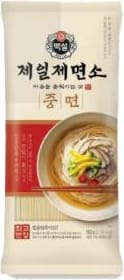
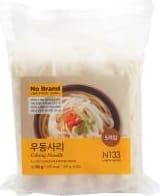
Short answer: almost no regular Korean instant ramen is vegetarian. Of the 210 noodle products in the official label data that publish allergen information, 37 (18%) list no meat or seafood, and 34 of those list no animal ingredient at all. Nearly all of them are plain noodles sold without a soup packet.
This is based on label data, not vegetarian certification. "No meat listed" means no meat, poultry, fish or seafood appears in the ingredient list or the allergen line. It does not rule out traces, and a few products are left out because an ingredient, often a flavouring or sauce base, does not say what it is made from.
Why the soup packet is the problem
Korean ramen soup is built on stock powders. Beef is the most common base, as 사골 (sagol, beef bone) or 쇠고기 분말 (beef powder), followed by chicken, pork and seafood: shrimp, squid, anchovy, dried bonito (가쓰오부시, katsuobushi) and oyster sauce. Ramen that looks like a vegetable dish is no exception. Nongshim Chal Bibim Myeon, a cold mixed noodle with a sweet chilli sauce, lists beef; Paldo Bibimmyeon Special lists beef and pork; Samyang Kimchi Ramen lists beef, pork and seafood.
Anchovy needs extra care. It is not one of Korea's mandatory allergens, so 멸치 (myeolchi, anchovy) appears only in the ingredient list, never in the allergen box. The same goes for most fish, including bonito.
What does qualify
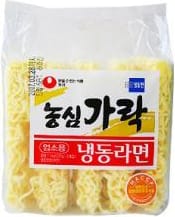
The products that pass are mostly noodles with no seasoning at all: 소면 (somyeon, thin wheat noodles), 중면 (jungmyeon, medium noodles), 칼국수 (kalguksu, knife-cut noodles), frozen udon, buckwheat noodles and 냉면 (naengmyeon) noodles sold without broth. A few products with a sauce also pass, such as Sempio Jaengban Bibim Makguksu, buckwheat noodles with a gochujang-based sauce, and a stir-fried spicy udon kit.
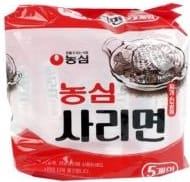
Then there is 사리 (sari): plain ramen noodle blocks sold for adding to stews and hot pots. Nongshim Ramen Sari Noodles and Samyang Baked Sari Noodles list no animal ingredient. Ottogi Ramen Sari Noodles lists no meat but does contain egg, through 난각분말 (eggshell powder), so it suits vegetarians but not vegans. That is most of the gap between the vegetarian and vegan counts.
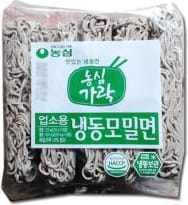
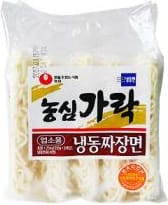
Making a vegetarian bowl
The practical route is a plain noodle plus a soup you choose yourself. Sari noodles or kalguksu with vegetables, tofu and a spoon of 고추장 (gochujang, chilli paste) or 된장 (doenjang, soybean paste) is close to the real thing. Check those pastes too, since some seasoned versions add anchovy or beef stock. Some brands also sell ramen marketed as vegan; look for 비건 (vegan) or 채식 (vegetarian) on the front and a vegan certification mark, and still read the label.
What to check on the label
For meat, look for 쇠고기 or 소고기 (beef), 사골 or 우골 (beef bone), 돼지고기, 돈골 or 돈지 (pork, pork bone, lard), 닭고기 or 치킨 (chicken). For seafood: 새우 (shrimp), 오징어 (squid), 멸치 (anchovy), 가쓰오부시 (bonito), 굴 (oyster), 홍합 (mussel), 게 (crab), 어묵 (fish cake) and 액젓 (fish sauce). Vague words deserve a second look: 육수 (stock), 엑기스 or 추출물 (extract) and 조미분 (seasoning powder) are often made from one of the above, so read what comes before them.
Vegans should also watch for 우유 (milk), 유청 (whey), 계란 or 전란 (egg), 난각분말 (eggshell powder) and 꿀 (honey). Much of the noodle data comes from the HACCP label dataset, which can be older than the package on the shelf, so the printed label is the final word.
Numbers are computed from the Food QR label data published by Korea’s Ministry of Food and Drug Safety and update every week. Products without allergen data (460) are excluded.