Buldak ingredients: real chicken, milk or pork in fire chicken?
K-Food Label · Updated Nov 2, 2026
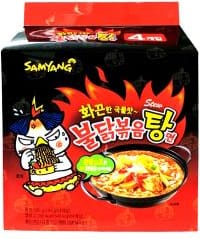
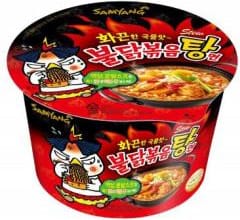
Buldak (불닭, 'fire chicken') was a fiery grilled-chicken dish before Samyang turned it into Buldak Bokkeummyeon, its stir-fried hot chicken noodles, in 2012. Now the flavour is on ramen, rice balls, gimbap, snacks and chicken feet. We checked 23 products with 불닭 in the name in the official Korean label data.
In short: the ramen is chicken flavour more than chicken, the ready meals and chicken feet are real chicken, and pork comes in with Spam or ham.
Is there real chicken in Buldak ramen?
Not as pieces. In Samyang's Buldak noodles, chicken appears in the sauce (스프, seupeu) as 그릴치킨농축액 (grilled chicken concentrate) and 치킨향분말 (chicken-flavour powder). Buldak Bokkeumtang Ramen, the stew-style version, lists chicken-flavour powder, and its Big Cup record states that the powder soup contains 0.62% chicken. That small amount of real chicken is why 닭고기 (dakgogi, chicken) is declared on nearly every Samyang Buldak record.
The exception is the HACCP record for Buldak Hot Chicken Ramen Cup: it lists grilled chicken concentrate but declares only wheat, soy, egg and milk. Such records can be older than the cup on the shelf, so trust the ingredient list here.
Milk and cheese, and not only in Carbo
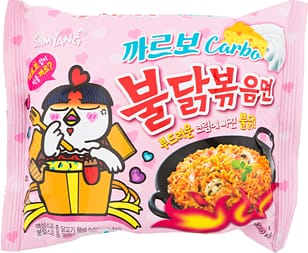
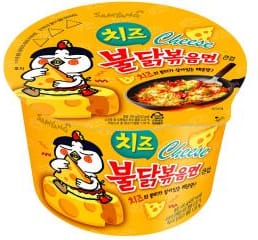
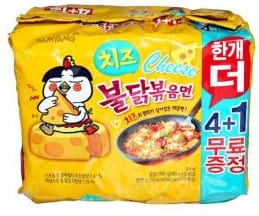
Carbo Buldak's sauce lists 혼합전지분유 (whole milk powder blend), cream-flavour powder, 모짜렐라치즈분말 (mozzarella cheese powder) and butter seasoning. Cheese Buldak and its Big Cup list 매운치즈소스 (spicy cheese sauce) and mozzarella powder. But milk (우유) and egg (계란) are declared on every Samyang Buldak noodle record, the original included, even though no dairy or egg ingredient appears in the original's ingredient text. They sit inside compound seasonings whose contents are not printed. If you avoid dairy, the original is not a dairy-free choice by its label.
Beef, seafood and pork in the noodles
Most Samyang Buldak noodle records also declare beef (쇠고기, soegogi), again with no beef word in the ingredient list. The Bokkeumtang and Cup records do not, but the Bokkeumtang noodle dough contains 해물베이스 (seafood base), and the Big Cup declares squid, shrimp and mussel. None of the Samyang Buldak noodle records declares pork. That does not make them halal: Samyang has certified versions for some export markets, but nothing in our data is certified, so look for the logo on your packet.
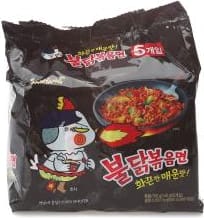
Buldak beyond noodles: real chicken
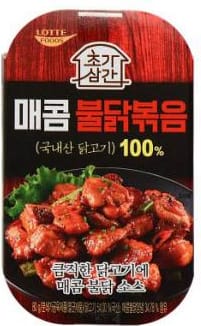
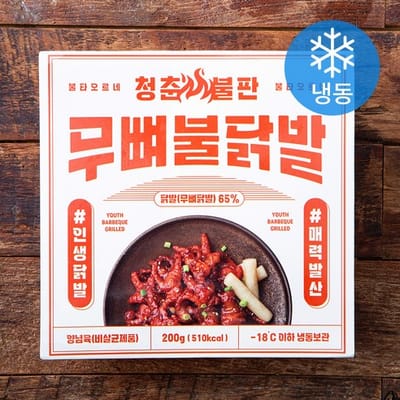
Corn Cheese Buldak Gimbap and Cheddar Cheese Buldak Rice Ball list chicken and cheese. Chicken feet, 불닭발 (buldakbal), are a classic spicy bar snack: Cheongchun Bulpan Boneless Fire Chicken Feet lists only boneless feet and a sauce of corn syrup, sugar, garlic and chilli, yet its allergen box declares milk, soy, wheat, tomato, beef and egg. Lotte Chogasamgan Spicy Buldak Stir-fry is chicken meat with sodium nitrite (아질산나트륨). Among snacks, Chicken Ball Cheese Buldak Flavor lists chicken, cheese, aspartame and 미림 (mirim, rice cooking wine).
Pork arrives with ham. Buldak Spam Tuna Gimbap, Buldak Spam Tuna Rice Ball and Bigger Spam Mayo Buldak Fried Rice Ball all declare pork, and Buldak Corn Cheese Rice Ball declares it too, with only an unnamed 양념육 (seasoned meat) in its ingredients. 스팸 (Spam) or 햄 (ham) in the name is the first warning.
Calories and sodium per pack
HACCP nutrition panels, as printed: Buldak Hot Chicken Ramen 530 kcal and 1,280 mg sodium per 140 g pack; Cheese Buldak 550 kcal and 1,440 mg per 140 g; Carbo Buldak 550 kcal and 1,330 mg per 130 g; Bokkeumtang Ramen 540 kcal and 1,870 mg per 145 g. The Korean daily value for sodium is 2,000 mg, so a pack of Bokkeumtang covers over 90% of it; the average across 160 noodle products with a usable panel is 1,381 mg. Panels can be older than today's packs, and the data has no spiciness figures.
How to check a Buldak product
On noodles, the ingredients are split into 면 (myeon, noodles) and 스프 or 소스 (sauce). Scan the sauce for 치킨 (chicken), 치즈 (cheese), 분유 (milk powder) and 해물 (seafood), then read the allergen box for 닭고기 (chicken), 쇠고기 (beef), 우유 (milk) and 계란 (egg), and on stew versions 오징어 (squid) and 새우 (shrimp). On rice balls and gimbap, check the name for 스팸, 햄 or 베이컨 (bacon) and the box for 돼지고기 (dwaejigogi, pork).
Numbers are computed from the Food QR label data published by Korea’s Ministry of Food and Drug Safety and update every week. Products without allergen data (460) are excluded.